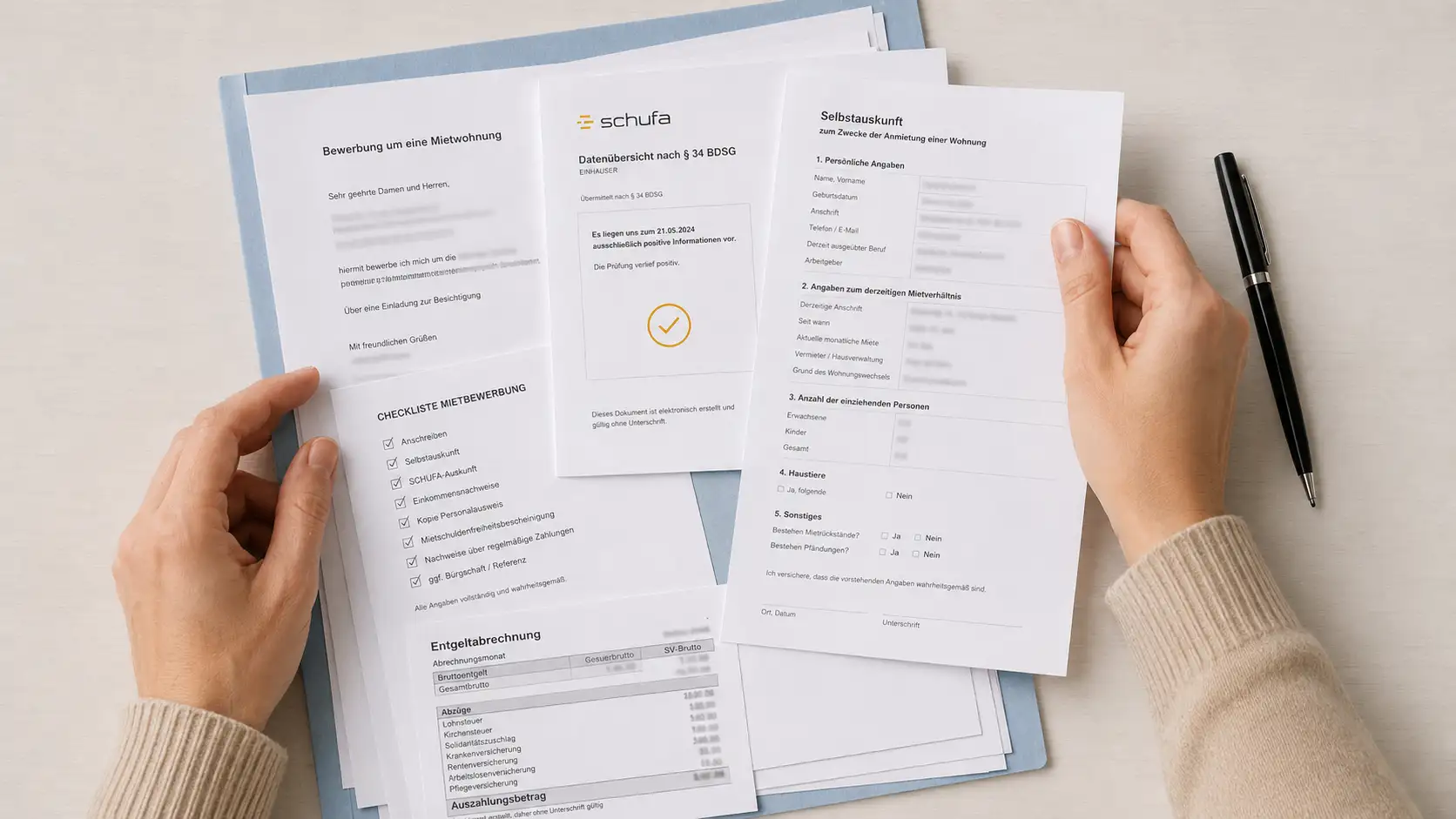
How to fill out the Mieterselbstauskunft: Tips and key information

Lukas Draheim · Real estate expert at rentcard
Published June 12, 2026 · Updated June 12, 2026
5 min read
Chapter overview
The Mieterselbstauskunft lands on your desk before you even know whether the apartment is right for you. Many applicants fill it out blindly without knowing which questions they must answer honestly, which they can decline, and what a false answer means legally. Here you get the complete picture.
Key takeaways
- Questions about income, employer, insolvency proceedings, and number of occupants are permitted and must be answered truthfully.
- Questions about pregnancy, religion, nationality, and criminal history are prohibited under AGG §1. False answers carry no legal consequences for you.
- Anyone who lies on permitted questions risks the tenancy being contested for fraudulent misrepresentation under BGB §123 and immediate termination.
- The most widely used templates come from Haus & Grund and the DMAG. Both cover all legally permitted questions in full.
- At rentcard, the CRIF credit report is linked directly to your digital application folder, giving landlords everything at a glance.
What does the Mieterselbstauskunft contain?
The Mieterselbstauskunft is not a legally required form. Landlords can use their own versions or rely on the standard templates from Haus & Grund or the German Tenants' Association (DMAG). In practice, almost all templates contain the same seven blocks.
The seven standard blocks
Personal data: Full name, current address, date of birth, and contact details. This block is unproblematic and matches what you provide in any contract.
Current housing situation: Length of current tenancy, current rent, and planned move-in date. Many forms also ask for the reason for moving. You can answer this briefly and neutrally.
Employment and employer: Name and address of the employer, type of employment (permanent or fixed-term), and how long you have been employed there. Self-employed applicants state their industry and job title.
Monthly net income: The landlord asks for the monthly net income because the rule of thumb is that cold rent should not exceed one third of net income. Someone earning 2,400 euros net can comfortably rent an 800-euro apartment.
Number and relationship of people moving in: Children, partner, flatmates. This information is permitted because the number of occupants directly affects wear on the apartment and consumption of water and heating.
Outstanding debts and insolvency proceedings: Whether insolvency proceedings have been opened or rent arrears from previous tenancies exist. Both are directly relevant to creditworthiness and are therefore permitted.
Pets and smoking: Whether you keep pets and whether you smoke. Both questions are permitted because they affect the condition of the apartment. Pets can be prohibited by contract, as can smoking indoors.
Permitted questions: What you must answer truthfully
A landlord may only ask questions in which they have a legitimate interest. The standard is simple: does the answer directly affect whether you can pay rent on time and whether you will treat the apartment with care? If yes, the question is permitted.
Income and employment are permitted because they demonstrate ability to pay. Open insolvency proceedings are permitted because a trustee may have control over the applicant's income. Previous rent arrears are permitted because they indicate past payment behaviour. Number of occupants is permitted because six people in a two-room apartment affect the building differently than a single person.
A credit check upfront saves time
Prohibited questions: What you may decline or answer untruthfully
Here lies the legally decisive point that many applicants do not know: when a landlord asks a prohibited question, you are not only allowed to stay silent or write 'no information'. You may also give a false answer, with no legal consequence whatsoever. The BGH has confirmed this in multiple decisions. The reasoning: someone who asks an impermissible question cannot expect a truthful answer.
The catalogue of prohibited questions is grounded in the General Equal Treatment Act (AGG) §1. Questions about pregnancy or family planning constitute prohibited discrimination on grounds of sex. Questions about nationality or ethnic origin are prohibited. Questions about religion or beliefs are prohibited. Questions about membership in a political party, tenants' association, or trade union are prohibited. Questions about criminal convictions or pending investigations are prohibited because they have no direct connection to rent payment.
Prohibited questions at a glance
- Pregnancy or family planning (AGG §1, discrimination on grounds of sex)
- Nationality or ethnic origin (AGG §1)
- Religion or beliefs (AGG §1)
- Political affiliation or trade union membership (AGG §1)
- Sexual orientation or identity (AGG §1)
- Existing illnesses or disabilities (except where directly affecting the apartment)
- Criminal convictions or pending investigations
- Hobbies, leisure activities, or taste in music
What happens when you lie on permitted questions?
Anyone who lies on permitted questions takes on a significant legal risk. The tenancy agreement can be contested for fraudulent misrepresentation under BGB §123. This means the landlord can have the contract declared void retroactively and demand immediate vacation. In addition, immediate termination under BGB §543 is possible if the false information fundamentally destroys the trust relationship.
A typical case: you state that no insolvency proceedings are open against you when in fact they are. Or you claim significantly higher income than you actually have. If this comes to light after the contract is signed, the landlord can both contest and terminate the agreement. Courts have almost consistently ruled in favour of the landlord in such cases.
The opposite applies to prohibited questions: you can provide false answers there without risk because the landlord has no legitimate interest in the answer. BGH case law expressly describes this as permitted self-defence against an impermissible question.
How to handle the self-disclosure form
Use one of the recognised standard templates if the landlord does not provide their own form. The Haus & Grund template (available free at haus-und-grund.de) and the DMAG template are the most widely used in the German property sector. Both cover all permitted questions and contain no prohibited fields.
Answer all permitted questions completely and truthfully. If your income is modest, it is better to state it honestly and back it up with a strong CRIF credit report than to conceal or inflate it. Landlords expect applicants who are not perfect fits, but they do not expect to be lied to.
For prohibited questions, writing 'keine Angabe' (no information) is sufficient. During a verbal conversation at a viewing, you can politely but clearly say: 'That is information I prefer not to share.' You are entitled to do so, and reputable landlords will accept it. Anyone who insists on an answer is demonstrating either ignorance of or disregard for the AGG.
Self-disclosure as part of your application folder
rentcard tip
Get your apartment faster with a verified profile
- Tenant self-disclosure
- Personal data
- Reusable for multiple applications
- Access to partner listings

Deckblatt
Deckblatt
Frequently asked questions
Answers to the most common questions about apartment hunting in Germany.
May the landlord ask about my pregnancy?
No. Questions about pregnancy or family planning are prohibited under AGG §1 as they constitute discrimination on grounds of sex. You may refuse to answer or give a false answer without any legal consequences.
What happens if I lie on the Mieterselbstauskunft?
Anyone who provides false information on permitted questions such as income or insolvency proceedings risks the tenancy being contested for fraudulent misrepresentation under BGB §123 and immediate termination. For prohibited questions, a false answer carries no legal consequences.
Which template should I use for the Mieterselbstauskunft?
The most widely used templates come from Haus & Grund (free at haus-und-grund.de) and the DMAG. Both cover all legally permitted fields and contain no prohibited questions.
Do I need to include a credit report with the Mieterselbstauskunft?
It is not legally required, but almost all landlords expect a current credit report. A CRIF report via rentcard can be embedded directly in your digital application folder and shared via a secure link.