Apartment hunting: Best tips & strategies

Lukas Draheim · Real estate expert at rentcard
Published June 10, 2026 · Updated June 7, 2026
8 min read
Chapter overview
You send enquiries, get no reply, and the next apartment disappears before you even get a chance to respond. The problem usually is not your application: you are simply not getting seen at all. This guide shows you how to change that.
Key takeaways
- ImmoScout24 and the other major portals receive hundreds of enquiries per day. Not replying within 30 minutes means your chances drop sharply.
- Networking and cold outreach on the ground brings apartments that are never publicly listed, often with zero competition.
- Send your rentcard folder with the initial enquiry, not after the viewing. That alone separates you from 90% of applicants.
- Kleinanzeigen, ohne-makler, Wohnglück, and Regionalimmobilien24 surface listings that rarely appear on the big portals.
- Properly configured search alerts mean tight price limits, no compromises on radius.
Know the portals and use them right
Not every portal works the same way, and which one you start with partly determines how fierce your competition will be. The platforms differ significantly in reach, renter demographics, and response dynamics.
ImmoScout24: largest reach, hardest competition
ImmoScout24 has the most listings in Germany – that means maximum choice, but also the fiercest competition. An attractive listing in Munich or Berlin can receive 50 to 100 enquiries within the first hour. Landlords often only read the first 10 to 15 messages. If you respond two hours later, you simply don't exist for many landlords.
The solution: set up push notifications on your phone, not just email alerts. Configure the alert to your core criteria: neighbourhoods, maximum cold rent, minimum size. Respond within 30 minutes of publication. Write a short, personal message, include the link to your rentcard folder immediately, and ask for a viewing appointment.
Immowelt, Kleinanzeigen, ohne-makler, Wohnglück and Regionalimmobilien24
Immowelt has a long track record and a loyal, established user base – with noticeably less competition per listing than ImmoScout24. Many property management companies in mid-sized cities prefer to list there.
Kleinanzeigen is the most underestimated portal – it's primarily used by private landlords who don't want to pay an agent fee, meaning no commission for you, more personal communication, and often less formal document requirements. ohne-makler offers similar direct-from-owner listings but with a particularly high standard of listing quality. Wohnglück and Regionalimmobilien24 round out the picture with strong regional coverage that rarely surfaces on the bigger platforms. Set up search agents on all portals so you never miss a listing.
WG-Gesucht: not just for flatshares
WG-Gesucht is the main platform for shared flat rooms, but also lists standalone apartments. If you're flexible and would consider a flatshare as a transitional option, you'll find the best selection here. Listings are sometimes posted directly by students and young professionals, so the personal touch in your message matters especially here.
Configure search alerts correctly
Activate your network: apartments that are never listed
A significant share of apartment moves in Germany happens informally. Landlords often prefer a recommendation from someone they know over an unknown applicant from the internet. If you don't use this channel, you're only competing with those who are equally disconnected.
Friends, colleagues, and social media
Actively tell everyone you're looking: colleagues, distant acquaintances, former classmates. Post in local Facebook groups like 'Wohnungen München', 'Wohnung gesucht Hamburg', or the specific neighbourhood variants. These groups often have several thousand members, and landlords post there precisely when they don't want mass enquiries through the big portals.
Make your post specific: how many people, pets yes or no, budget, desired neighbourhoods, from when. Vague posts like 'urgently looking for apartment' get no responses. 'Quiet couple, no children, no pets, up to 1,200 euros cold rent, Schwabing or Maxvorstadt preferred, from August' is shareable and gets forwarded.
Cold outreach in your target neighbourhood
Walk through the streets of your target neighbourhood and note the names of property management companies on door buzzers or entrance signs. Many buildings are managed by local Hausverwaltungen that don't actively list on portals but regularly need new tenants. A short email or letter to the property manager with your enquiry takes little time and often generates surprisingly good results, precisely because almost nobody does it.
In Munich, for example, GEWOFAG and GWG München both run their own application portals. In Augsburg, GEWOBAU manages a significant share of rental housing stock. Registering directly on their waiting lists bypasses the portal jungle entirely. You can find more city-specific strategies in the guides on finding an apartment in Munich and finding an apartment in Augsburg.
Why speed beats the cover letter
Most apartment-hunting guides focus on the perfect cover letter. That's not wrong, but it's also not where most applications fail. The application that arrives too late simply isn't read.
A landlord who publishes a listing wants to find a reliable tenant as quickly as possible. If after 30 minutes they already have 20 serious enquiries with complete documents, they have no reason to wait. Someone who writes after three hours is still in the running. Someone who writes after two days usually is not.
The rentcard folder in the first message
That doesn't mean you should send a poor cover message. Three to five sentences explaining who you are, why this apartment suits you, and that all documents are attached via link. That is enough. No novel, no life story. Landlords read many enquiries, and someone who gets to the point is perceived as a more pleasant candidate.
Documents ready instantly, not assembled on request
The most common reason for missing out on apartments is mundane: documents aren't in order. Last month's payslip is missing, the CRIF credit report has expired, the ID photo hasn't been scanned. If you start gathering these things after a landlord responds, you lose hours while others have already confirmed.
What landlords always require
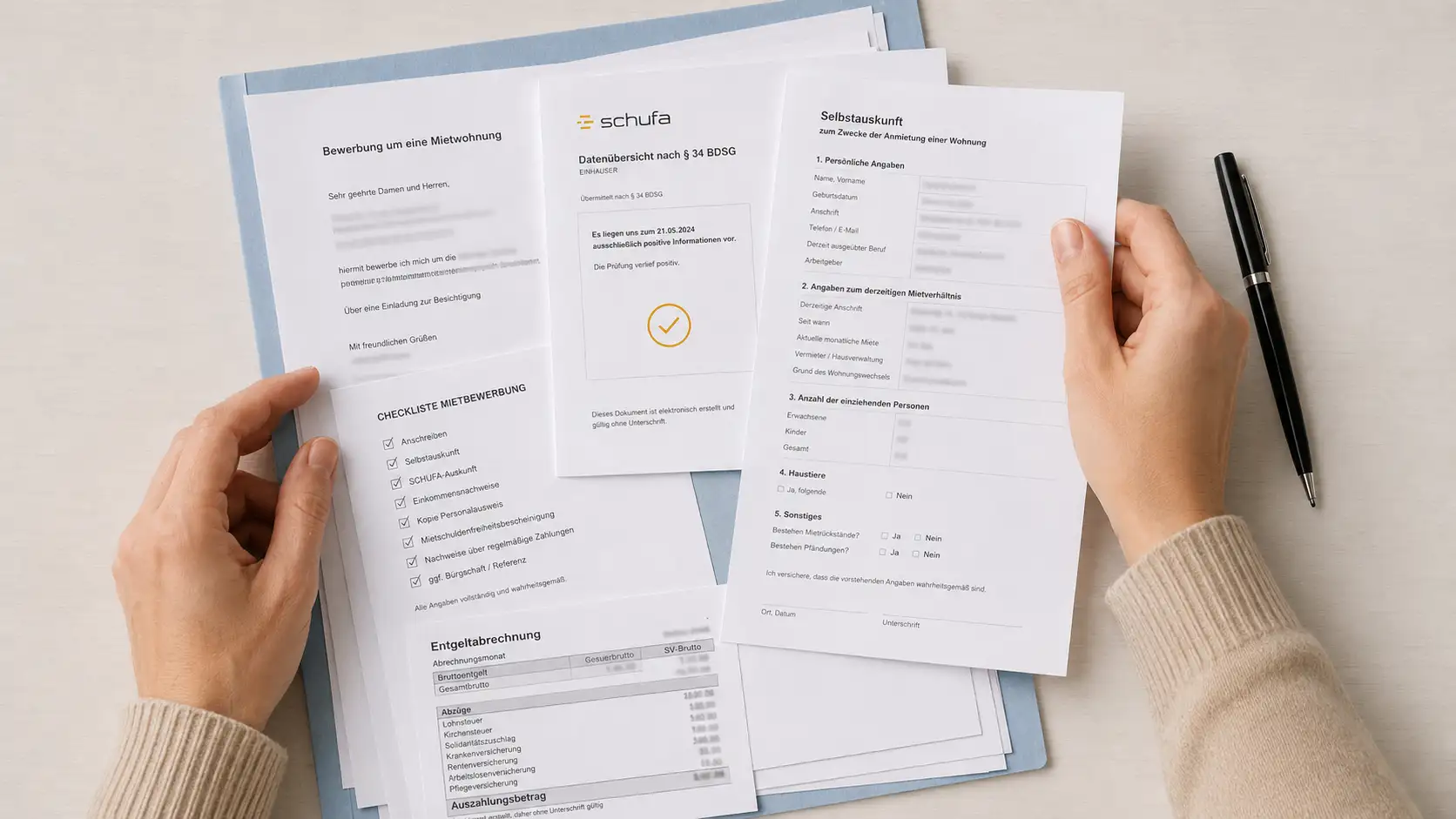
Standard for almost every application in Germany: a national ID or passport, payslips from the last three months (for self-employed: last tax assessment), a current CRIF credit report, a completed Mieterselbstauskunft (tenant self-disclosure form), and optionally a guarantor letter, for example if your net income is below three times the cold rent. What a Mieterselbstauskunft contains is explained in detail in the Ratgeber article on the Mieterselbstauskunft.
With rentcard, you upload these documents once, they get verified, and you can share them via link with any landlord, without rescanning or emailing PDF packages every time. During an intensive search, that saves several hours per week.
Checklist: prepare documents before you start searching
- National ID or passport as PDF or photo
- Payslips from the last 3 months (or tax assessment)
- Current CRIF credit report (not older than 3 months)
- Completed and signed tenant self-disclosure form
- Rent-free certificate from your last landlord (optional but helpful)
- Upload all documents to rentcard and have the link ready
rentcard tip
Get your apartment faster with a verified profile
- Tenant self-disclosure
- Personal data
- Reusable for multiple applications
- Access to partner listings

Deckblatt
Deckblatt
Impressing the landlord: after getting a viewing confirmation
You've received a viewing invitation. That means you've cleared the first hurdle. Now the second part begins. Landlords rarely invite more than five to eight people to a viewing. Your goal is no longer to be seen, but to become the favourite.
Arrive on time. Dress neatly but not overdressed. Show genuine interest in the apartment and the building. Ask about the last heating bill, the heating system, and the neighbours. Landlords who have lived in the building respond very positively to that kind of specific curiosity.
Send a short, personal message after the viewing, within two hours, not the next day. 'Thank you for the viewing, I really liked the apartment, especially how quiet it is. I would be very happy if it works out.' Three sentences are enough. Landlords remember the person who followed up. More tips on this are in the Ratgeber article on preparing for a viewing.
Apartment hunting feels like a numbers game only for those who act without a strategy. Anyone who uses the portals correctly, activates their network, has documents ready immediately, and responds quickly can cut the average search time from four to six months down to a few weeks. The basics are simpler than most people think.
Frequently asked questions
Answers to the most common questions about apartment hunting in Germany.
How quickly do I need to respond to a listing?
As fast as possible, ideally within 30 minutes of publication. Attractive listings on ImmoScout24 often receive 50 to 100 enquiries in the first hour. Landlords frequently only read the first 10 to 15. Respond too late and you simply will not be considered.
Which portals are worth using to find an apartment in Germany?
ImmoScout24 has the widest reach but also the fiercest competition. Immowelt has a long track record and a loyal user base, with noticeably fewer competitors per listing. Kleinanzeigen is great for private landlords renting without an agent. ohne-makler offers vetted direct-from-owner listings at a high quality standard. Wohnglück and Regionalimmobilien24 cover strong regional inventory. WG-Gesucht is the first stop for shared flat rooms.
When should I send my documents to the landlord?
With the very first enquiry, not after the viewing. Including the link to your rentcard folder straight away shows immediately that you are prepared and serious. That gives you a concrete advantage over applicants who only provide documents when asked.
How do I find apartments that are never publicly listed?
Walk through your target neighbourhood and note property management company names on door buzzers. Send them a short enquiry. Use Facebook groups like 'Wohnungen [Stadt]'. Actively tell friends, colleagues, and acquaintances you're looking. Many landlords prefer referrals and never list publicly at all.