Finding an apartment in Munich: Practical tips and strategies

Lukas Draheim · Real estate expert at rentcard
Published June 12, 2026 · Updated June 12, 2026
7 min read
Chapter overview
Anyone searching for an apartment in Munich knows the reality: a listing appears, and within 48 hours there are 100 to 300 enquiries. If you don't apply immediately, completely, and convincingly, your chances are slim. This guide shows you which portals actually dominate in Munich, which neighbourhoods are still somewhat affordable, and why the large housing companies could be your safest long-term route.
Key takeaways
- Popular listings receive 100 to 300 enquiries within 48 hours – if you have not heard back after three days, assume a rejection.
- ImmoScout24 dominates Munich; Immowelt, ohne-makler, and Wohnglück are strong additions – Facebook groups surface listings that appear on no portal.
- GEWOFAG (approx. 36,000 units) and GWG München (approx. 30,000 units) have waiting lists – register immediately, even if you need the apartment a year from now.
- Cold rent in Munich: city average 21 to 24 euros per m²; Giesing and Pasing from 18 euros; Schwabing and Maxvorstadt up to 28 euros.
- Augsburg is 30 minutes away and 35 to 40 percent cheaper – for many commuters the more realistic choice.
Rents by neighbourhood: What you actually pay in 2025/2026
The Munich rent index for 2024 shows a net cold rent of 21 to 24 euros per square metre on average – but that is the city average. Depending on location, the prices actually listed in new-build adverts are significantly higher or slightly lower. The following overview shows what is charged in practice.
Expensive areas: Schwabing, Maxvorstadt, Bogenhausen
Schwabing and Maxvorstadt sit at 25 to 28 euros per m² cold. Bogenhausen and the old town surroundings reach similar levels. A 60 m² apartment here costs 1,500 to 1,700 euros in cold rent. Add ancillary costs of often 250 to 350 euros – especially in older buildings with poor energy ratings. Always ask to see the last heating cost statement at the viewing before you sign.
Mid-range areas: Giesing, Obergiesing, Sendling
Giesing and Obergiesing have developed strongly in recent years. Cold rents in 2025/2026 sit at 19 to 22 euros per m². Sendling is similar. Both neighbourhoods are well connected by underground and are increasingly popular – which continues to push prices up. Those searching there today pay less than in Schwabing, but more than three years ago.
More affordable areas: Pasing, Aubing, Neuperlach, Riem
Pasing and Aubing in the west sit at 18 to 21 euros per m². Neuperlach and the Messestadt Riem area in the east are the relatively cheapest Munich neighbourhoods at 17 to 20 euros per m² – and still well connected. From Neuperlach you reach Marienplatz in about 20 minutes on the U5, from Messestadt Riem in about 25 minutes. For people who do not mind commuting, there is hardly a better choice within the city limits.
Check ancillary costs in older buildings
The right portals for the Munich apartment search
In Munich there is a clear hierarchy among search portals. Using all of them gives you an edge – but watching only one portal means regularly missing good listings.
ImmoScout24: The most important portal in Munich
ImmoScout24 has the widest reach in Munich – large property managers and many private landlords list here. Set up a search profile with instant push and email notifications. The Premium profile pays off in a market with 300 competitors per listing: your profile appears higher up to landlords.
Facebook groups: Where listings appear that are never advertised
Two groups are essential: "Wohnung München" (several hundred thousand members) and "Wohnungstausch München" for swap requests. Private individuals offer apartments here directly without paying portal fees. That means: fewer competitors, more direct contact, faster decisions. Always write a short, personal message – not a mass text, but one sentence explaining why you are interested in this specific apartment.
Immowelt, ohne-makler, Wohnglück and Regionalimmobilien24
Immowelt has a long track record and a loyal user base – the second-largest portal in Munich, with noticeably less competition per listing than ImmoScout24. ohne-makler features carefully vetted listings from owners renting without an agent, with above-average listing quality. Wohnglück and Regionalimmobilien24 cover segments that rarely surface on the major portals. It is also worth contacting large Munich property managers directly – many units are passed on internally before ever appearing online.
Apply immediately with a complete folder
GEWOFAG and GWG: The waiting list worth joining
Munich's two largest municipal housing companies are GEWOFAG and GWG München. Those who secure an apartment there often pay significantly less than on the open market and benefit from stable tenancies. Registration is the first step.
GEWOFAG: The largest municipal landlord in Munich
GEWOFAG manages around 36,000 apartments in Munich and is the largest municipal housing provider in the city. Vacant apartments are allocated via the waiting list at gewofag.de. Waiting times depend heavily on the desired apartment size and district. Registering now puts you in a better position than registering a year from now. The apartments are often cheaper than comparable market offerings because GEWOFAG has a social mandate.
GWG München: The second option for stable housing
GWG München manages around 30,000 apartments within the city. Registration and waiting list are at gwg-muenchen.de. Additionally worth checking: Baugenossenschaft München. Here you purchase membership shares and then apply for cooperative apartments. The waiting time is long, but those who secure a place live on stable terms without fear of short-notice owner-occupancy terminations.
How to apply successfully in Munich
Munich landlords sort through applications quickly. Anyone who sends incomplete documents or answers a question with "coming soon" goes straight to the rejection pile. These three points make the difference.
Completeness before speed
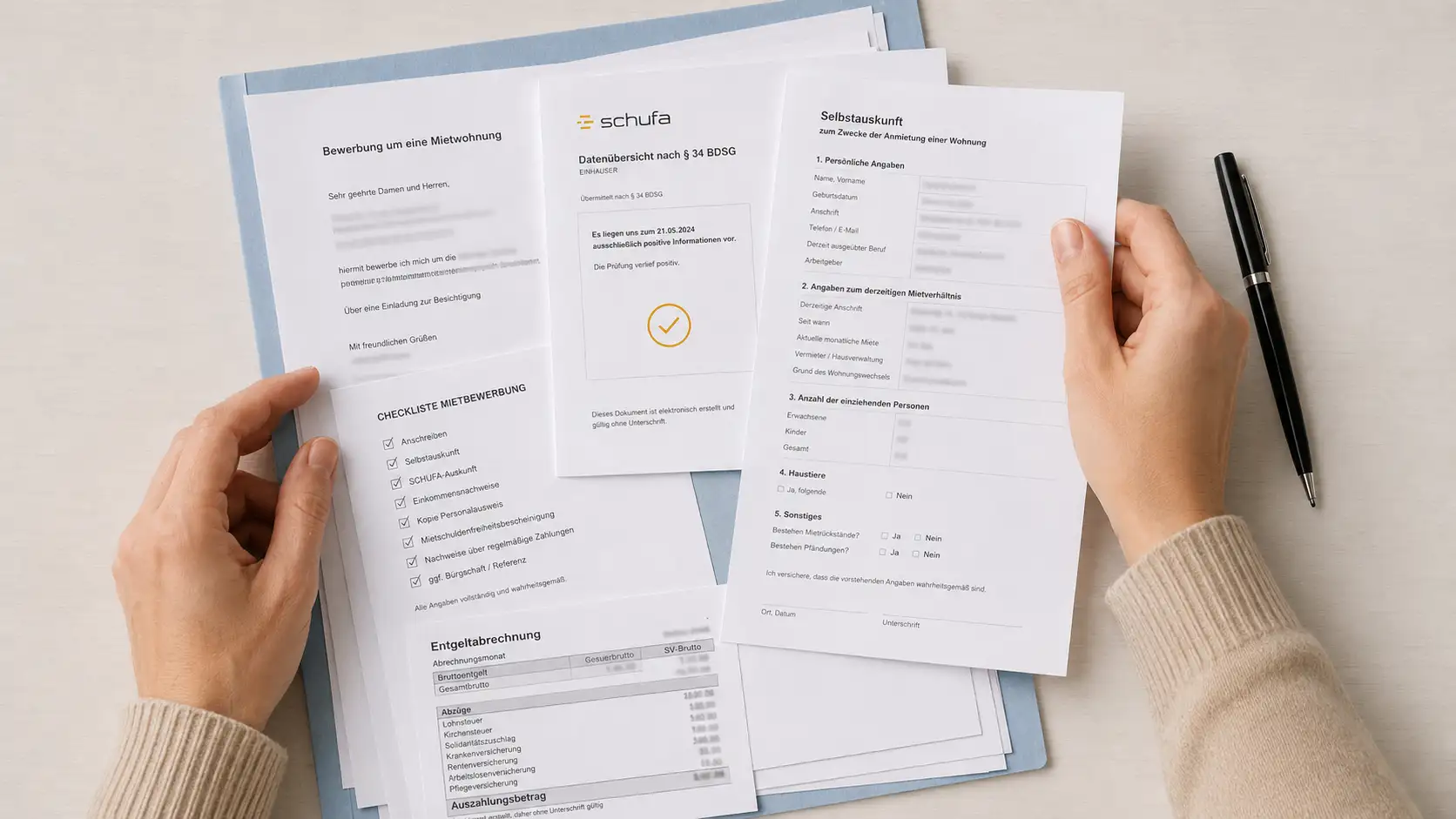
Being quick matters, but a fast application without complete documents achieves nothing. Landlords expect proof of income, a CRIF credit report, a copy of your ID, and a rent-free certificate – all in one document. The rentcard link gives you exactly that: a complete, verified folder you can share in seconds. More guidance on which documents belong in a strong application folder can be found in the article on creating a Bewerbermappe.
The first message decides
Most Munich landlords do not read every application in full. Your first message must explain in two sentences who you are, when you can move in, and that your documents are complete. Do not write generic texts. "I am employed, earn 4,200 euros net, can move in from 1 August, and am happy to send my complete folder" is better than three paragraphs about your personality.
At the viewing: appear confident and prepared
Arrive on time, dress neatly, and bring printed documents – even if you have already sent the folder digitally. Ask specific questions: How high were the ancillary costs last year? When was the heating last serviced? Is there a basement allocation? Landlords take applicants seriously who show they are planning a long-term tenancy. Tips for optimally preparing for viewings can be found in the article on besichtigungstermin-vorbereiten.
Augsburg as a genuine alternative: 30 minutes, 35 percent cheaper
If you work in Munich, you do not have to live in Munich. Augsburg is reachable by regional express in around 30 minutes – with a train every 30 minutes, reliably on time. Cold rents there sit at 12 to 16 euros per m², which is 35 to 40 percent cheaper than Munich. A 70 m² apartment in Augsburg often costs 850 to 1,100 euros cold; the same apartment in Munich would cost 1,470 to 1,680 euros.
Augsburg also has its own vibrant infrastructure: universities, a good cultural offering, and neighbourhoods with character. Those who cannot or do not want to pay Munich rents should not see Augsburg as a compromise, but as an independent option with genuine advantages. Detailed information on apartment hunting in Augsburg can be found in the article wohnung-finden-augsburg.
Complete your application folder before you start searching
Frequently asked questions
Answers to the most common questions about apartment hunting in Germany.
How much does an apartment in Munich cost in 2025?
Munich's city average in 2025/2026 is 21 to 24 euros per m² cold. Schwabing and Maxvorstadt cost 25 to 28 euros, Neuperlach and Messestadt Riem 17 to 20 euros. A 60 m² apartment costs between 1,020 and 1,680 euros in cold rent depending on location.
How quickly do I need to apply for a Munich apartment?
Popular listings receive 100 to 300 enquiries in the first 48 hours. If you have not heard back after three days, assume a rejection. Prepare your rentcard folder before you start searching so you can include a complete application with your very first message.
Register with GEWOFAG or GWG: Is the waiting list worth it?
Yes, definitely. GEWOFAG (approx. 36,000 units, gewofag.de) and GWG München (approx. 30,000 units, gwg-muenchen.de) often allocate apartments below market price. The waiting time can be long, but registering now puts you in a much better position a year from now than someone who starts then.
Is Augsburg a realistic alternative to Munich for commuters?
For many, yes. Augsburg is reachable by regional express in around 30 minutes, with trains every 30 minutes. Cold rents sit at 12 to 16 euros per m², which is 35 to 40 percent cheaper than Munich. Those willing to commute can save several hundred euros per month.