Finding a rental apartment in Germany: Tips, tricks and more

Lukas Draheim · Real estate expert at rentcard
Published June 12, 2026 · Updated June 12, 2026
8 min read
Chapter overview
The German rental market runs on rules that catch many newcomers off guard: apartments are often let without a kitchen, the average tenancy lasts 11 years, and instead of a credit score number like in the US or UK, every landlord expects a CRIF credit report. Knowing these rules from the start saves you weeks.
Key takeaways
- German apartments are often let without a fitted kitchen (Einbauküche) – check the listing carefully before booking a viewing.
- Rents vary widely: Munich 21–24 €/m², Berlin 14–18 €/m², Cologne/Düsseldorf 13–16 €/m², mid-sized cities from 8 €/m².
- The security deposit is capped by law at three months of net rent (BGB §551) – you should not pay more.
- After moving in you must register at the Einwohnermeldeamt within 14 days – for this you need the Wohnungsgeberbestätigung form from your landlord.
- With a complete application folder including a CRIF credit report, you can respond to listings immediately without losing time collecting documents.
How the German rental market actually works
Moving to Germany from abroad means encountering a tenancy law that heavily protects tenants – and is formalised precisely because of that. Open-ended contracts are the norm; landlords can only terminate them for legally defined reasons (personal use, serious breach of contract). The result: the average tenancy in Germany lasts 11 years, with many tenants staying far longer. Landlords respond by being more thorough in their selection process than in most other countries.
Another difference: Germany has no unified credit score number like the US or UK. Instead, landlords request a credit report from CRIF, which lists outstanding debts, collection proceedings, and insolvency entries. The report contains no numerical score, but a statement on creditworthiness. New to Germany? You may not yet have any CRIF entry at all – that is not a disadvantage as long as your other documents are complete.
Apartments without a kitchen: what it means
Rent prices 2025/2026: city-by-city comparison
Rents in Germany vary enormously – a 70 m² apartment in Munich costs more than twice as much as one in Magdeburg. The figures below are for average existing apartments (not new-build) in typical urban locations:
Major cities: the most expensive markets
Munich is the most expensive market in Germany at 21–24 €/m² net rent – for a 60 m² apartment you pay 1,260–1,440 € cold, plus 200–300 € in utilities. Frankfurt sits at 17–21 €/m², Hamburg at 16–19 €/m², and Stuttgart likewise at 16–19 €/m². Berlin is somewhat cheaper at 14–18 €/m², but demand is so high that good apartments go within 48 hours. Cologne and Düsseldorf run at 13–16 €/m².
Mid-sized cities: affordable alternatives
Those who work remotely or can commute will find significantly better conditions in mid-sized cities. Leipzig, Dresden, and Magdeburg sit at 8–11 €/m², Nuremberg and Hanover at 10–13 €/m², Dortmund and Duisburg similarly. The downside: these markets have also risen noticeably since 2020, and the stock of available apartments is limited in some segments. If you are moving to Munich specifically, the guide to finding an apartment in Munich covers that market in detail.
Do not overlook utilities
Step 1: The right portals and search profiles
ImmoScout24 is the largest portal with the widest selection – most searches start there. Immowelt has a long track record and a loyal user base; many exclusive listings appear there that do not appear on ImmoScout24. ohne-makler offers vetted direct-from-owner listings at a high standard of quality. WG-Gesucht is essential for flat-shares and temporary sublets. Kleinanzeigen is worth checking for private landlords who want to avoid agency fees. Wohnglück and Regionalimmobilien24 add strong regional coverage to the mix.
On every platform: create a search profile, set a maximum price range and minimum size, and activate instant email alerts. In Munich or Berlin, apartments are often taken within 2–4 hours – if you only check in the evening, you have often already lost. More specific tips for the digital apartment search are covered in the Wohnungssuche-Tipps article.
Step 2: The complete application folder
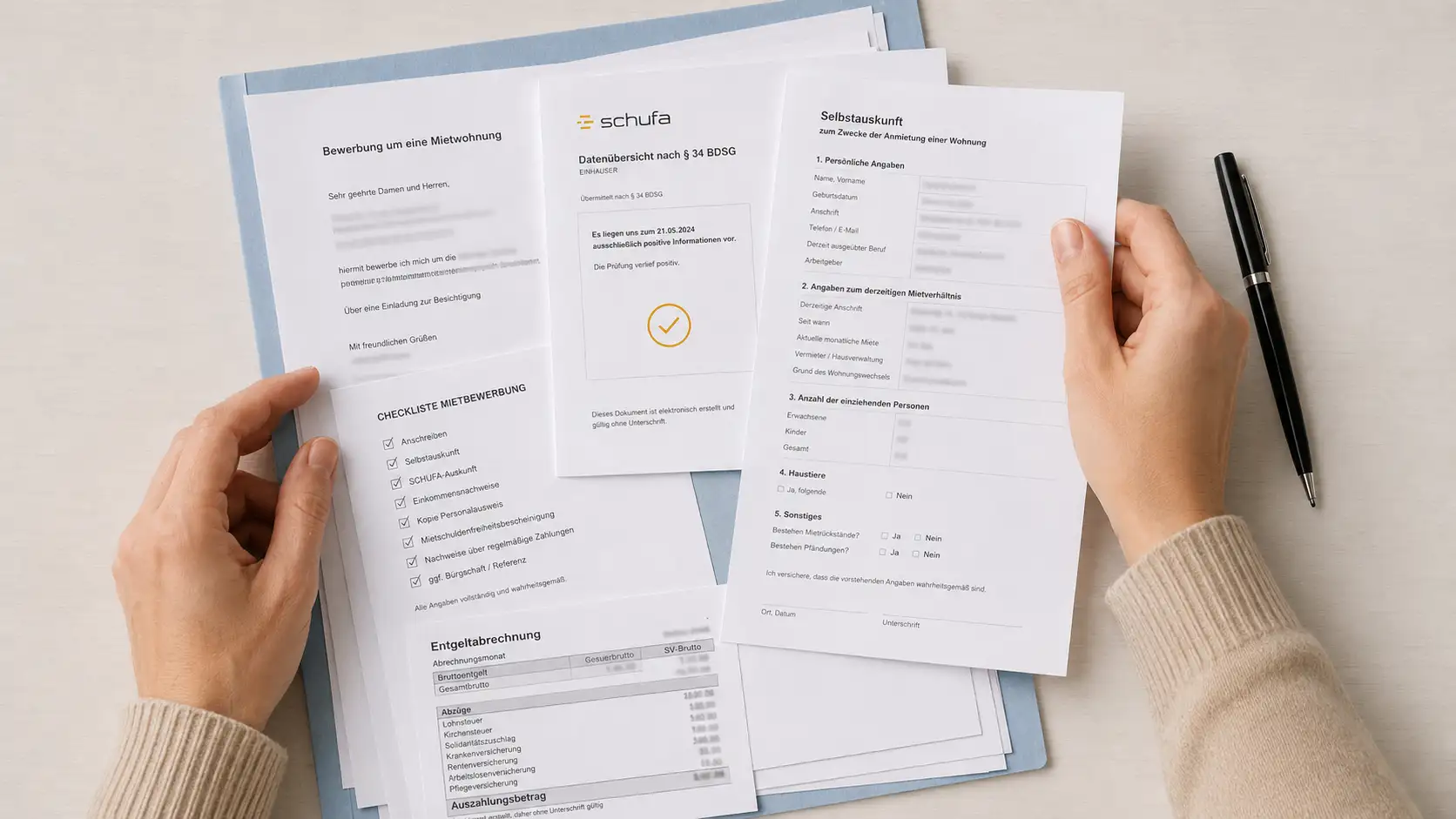
An incomplete application is ignored in a competitive market. Assemble all documents before you start actively searching, so you can respond immediately when the right listing appears. These six documents every serious landlord expects:
The six essential documents
- Passport or ID card (copy)
- Payslips from the last three months
- Current proof of income or employment contract
- CRIF credit report (no older than 3 months)
- Rent-free certificate from your current landlord
- Completed tenant self-disclosure form (Mieterselbstauskunft)
With rentcard you upload all these documents once and integrate your verified CRIF credit report directly into the folder. When you respond to a listing, you simply send the folder link – no email attachments, no repetition. The article on creating your Bewerbermappe walks through each step in detail.
Step 3: Nailing the viewing
A viewing in Germany is not a walk-through – it is a mutual getting-to-know-you. The landlord watches how you treat the apartment, what questions you ask, and how you conduct yourself around other applicants. Arrive on time (5 minutes early is considered respectful), dress tidily without being overly formal, and bring your application folder either printed or as a sent link.
Inspect the apartment systematically: look inside all cupboards and check for moisture stains on walls or ceilings. Test all windows (do they open and close easily?). Check the water pressure in the bathroom. Ask for the last two years of annual utility statements (Nebenkostenabrechnung) – large back-payments are a warning sign. More on preparing for viewings is covered in the besichtigungstermin-vorbereiten article.
Step 4: Reading the rental contract correctly
The rental contract is the most important document in the entire process. Read it in full before signing. Four points deserve particular attention:
Security deposit: capped by law at three months
Under BGB §551, the security deposit may not exceed three months of net cold rent. This is a hard ceiling, not a starting point for negotiation – a higher amount would be legally void. You may pay the deposit in three equal monthly instalments, starting with the first rent payment. The deposit must be held separately from the landlord's personal assets (e.g. in a dedicated escrow account) and returned with interest at the end of the tenancy – the landlord typically has up to six months if utility reconciliations are still pending.
Utilities: advance payment versus flat rate
With a utility advance payment (Vorauszahlung) you pay a monthly estimate and receive an annual reconciliation with either a back-payment or refund. With a utility flat rate (Pauschale) the amount is fixed – no additional charges, but also no refunds. The flat rate sounds more convenient but can become more expensive if heating costs rise. Before signing, ask exactly which utilities are included – heating, water, waste, caretaker, lift?
Notice period: three months as the standard
The statutory notice period for tenants is three months, counted to the end of the month (BGB §573c). For landlords it extends with tenancy length: to six months after five years, and nine months after eight years. Cosmetic repair clauses (Schönheitsreparaturen) are a common source of disputes – blanket renovation obligations (e.g. "repaint every three years") are invalid under Federal Court of Justice (BGH) case law. If your contract contains such a clause, you have no obligation to redecorate when you leave.
rentcard tip
Get your apartment faster with a verified profile
- Tenant self-disclosure
- Personal data
- Reusable for multiple applications
- Access to partner listings

Deckblatt
Deckblatt
Step 5: After moving in – what to do immediately
Anmeldung at the residents registration office: mandatory within 14 days
Registration (Anmeldung) is a legal obligation, not a suggestion. You must register at the Einwohnermeldeamt (also called Bürgeramt) of your municipality within 14 days of moving in. Late registration risks a fine of up to 1,000 €. For the registration you need: your passport or ID card, and the Wohnungsgeberbestätigung.
Wohnungsgeberbestätigung: what it is and why you need it
Move-in inspection report: your most important document on day one
The Übergabeprotokoll (move-in inspection report) documents the condition of the apartment on the day keys are handed over. Record all existing defects – scratches, stains, damaged tiles, cracks – in writing and photographs, and have both parties sign the report. Without this document you will find it very difficult to prove at move-out that a defect already existed before your tenancy. Also photograph all meter readings (electricity, gas, water) on day one.
WBS: subsidised housing and the Wohnberechtigungsschein
The Wohnberechtigungsschein (WBS) entitles you to rent a subsidised social housing apartment at below-market rent. Income limits vary by city and household size: in Munich the limit for a single-person household is around 26,000 € gross annual income, slightly higher in Berlin. Families with children have significantly higher limits.
You apply for a WBS at your city's Wohnungsamt (housing office). Even if your income slightly exceeds the limits, it is worth checking your eligibility – there are different WBS categories (WBS 100, WBS 140, WBS 160) with different thresholds. In cities like Munich or Berlin the stock of social housing is so limited that waiting times of several years are not unusual. Still: apply early, as a WBS cannot be backdated and the waiting time runs from the date of application.
Contact municipal housing companies directly
Frequently asked questions
Answers to the most common questions about apartment hunting in Germany.
What do I need to rent an apartment in Germany as a foreigner?
You do not need a German passport. You need a valid ID, a CRIF credit report (possible even without German credit history), proof of income, and after moving in you must register at the Einwohnermeldeamt within 14 days. For that you need the Wohnungsgeberbestätigung form from your landlord.
How much does an apartment cost in Germany in 2025?
Net cold rents vary widely: Munich 21–24 €/m², Frankfurt 17–21 €/m², Berlin 14–18 €/m², Hamburg and Stuttgart 16–19 €/m², Cologne and Düsseldorf 13–16 €/m², mid-sized cities like Leipzig or Hanover 8–13 €/m². Add utilities of 2.50–3.50 €/m² on top.
How much can a landlord charge as a security deposit in Germany?
A maximum of three months of net cold rent under BGB §551. Charging more is legally void. You may pay the deposit in three equal monthly instalments. At the end of the tenancy the deposit must be returned with interest, typically within three to six months.
What is the Wohnungsgeberbestätigung and why do I need it?
The Wohnungsgeberbestätigung is a mandatory form your landlord must complete after you move in. You need it to register at the Einwohnermeldeamt. Without that registration you cannot get a Meldebescheinigung, and without a Meldebescheinigung almost nothing in Germany is possible: no bank account, no public health insurance, no tax ID.