Everything you need to know about apartment hunting

Lukas Draheim · Real estate expert at rentcard
Published June 12, 2026 · Updated June 12, 2026
6 min read
Chapter overview
Apartment hunting in Germany means moving fast, having complete documents ready, and convincing landlords within minutes. In Munich, Frankfurt, and Hamburg expect a search of two to five months. Berlin is currently somewhat easier at six to ten weeks; mid-sized cities like Leipzig or Hanover average three to six weeks. This guide walks you through all five phases.
Key takeaways
- In Munich and Frankfurt a realistic search takes two to five months; Berlin and Leipzig are currently faster.
- A complete application folder with a CRIF credit report and verified income documents before the first viewing is no longer optional.
- There are often one to two weeks between the viewing and an offer; following up deliberately keeps you in the running.
- The deposit (Kaution) may not exceed three months of cold rent under BGB §551 and can be paid in three instalments.
- If you are considering subsidised housing: the Wohnberechtigungsschein (WBS) has income thresholds set by the Wohnraumförderungsgesetz.
Phase 1: The search
ImmoScout24, Immowelt, WG-Gesucht, ohne-makler, Kleinanzeigen, Wohnglück, and Regionalimmobilien24 together cover the German rental market. Set up search profiles on the portals most relevant to you and enable both email and push notifications for instant alerts. Respond within the first two hours of a listing going live: landlords in desirable locations often close their inbox after 24 hours once they have enough enquiries.
Supplement the portals with offline channels. Many apartments are never publicly listed: landlords prefer personal recommendations. Tell friends, colleagues, and neighbours you are looking, and post in local Facebook groups like "Wohnungen in München". Municipal housing companies such as GEWOFAG or GWG in Munich and GEWOBAU in Augsburg maintain their own waiting lists; registering is free and worthwhile if your timeline allows.
Getting your search strategy right
Set your search area deliberately wider than your target neighbourhood. In Munich, average cold rent for a two-room apartment runs between 22 and 28 euros per square metre; a few S-Bahn stops further in Pasing or Moosach you save four to six euros per square metre for ten to fifteen minutes of extra commute. Use the map view on ImmoScout24 or Immowelt to directly estimate travel time to your office. More specific recommendations for individual cities can be found in the articles on finding an apartment in Munich and finding an apartment in Augsburg in this Ratgeber.
Phase 2: Preparing your application folder
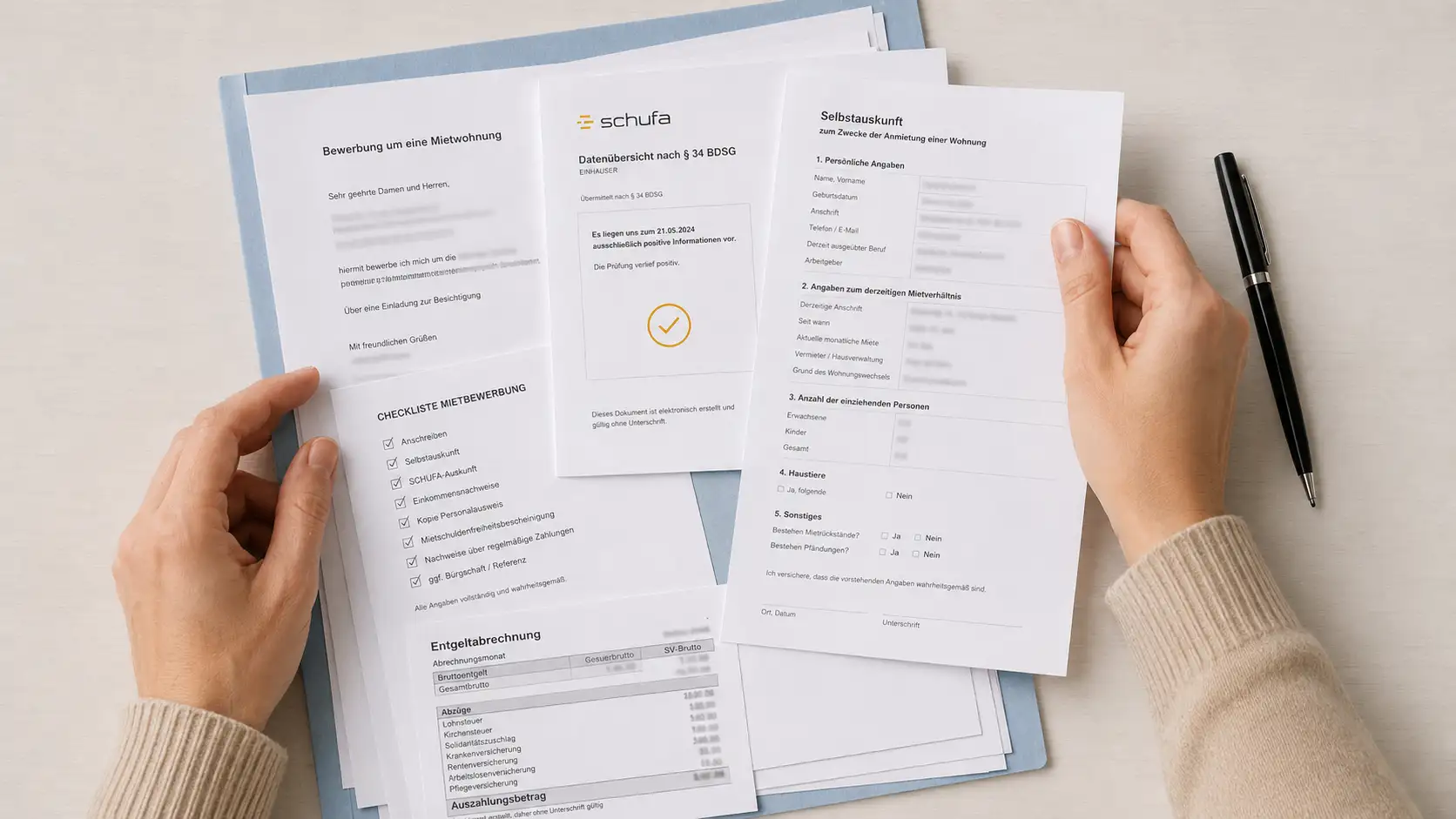
Being able to submit a complete folder immediately after a viewing often wins the apartment the same day. The folder should contain: photo ID, payslips from the last three months (or tax assessment and income statement for the self-employed), a CRIF credit report, a completed tenant self-disclosure form, and a guarantor letter if applicable. Many landlords today also ask for a Mietschuldenfreiheitsbescheinigung confirming you owe nothing to your previous landlord.
With rentcard you assemble this folder once, verify your identity and income via Open Banking, and share it via a link from then on. No re-scanning, no sending originals by email. The article on creating your Bewerbermappe explains step by step which documents you need and how to prepare them.
Tip: order your credit report in advance
Phase 3: The viewing
A viewing is not a walkthrough but a mutual interview. Landlords often decide based on the first personal impression, not solely on the contents of the application folder. Arrive five minutes early and dress neatly but not overdressed. Ask targeted questions: what were the utility costs last year? When was the heating system last serviced? Are any renovation works planned in the building?
Check the apartment systematically: look for damp stains on exterior walls and in corners, test the water pressure at all taps, check your mobile signal, and verify that all sockets and light switches work. Note defects immediately and clarify whether they will be fixed before you move in. The separate article on preparing for a viewing gives you a complete checklist.
What to check at the viewing
- Damp marks on exterior walls and in corners
- Ask for the last heating bill (benchmark: under 1.50 euros per square metre per month)
- Test mobile and internet signal on site
- Open windows and check sound insulation
- Check whether cellar and attic are usable
- Share your rentcard folder link right after the viewing
Phase 4: Between viewing and offer
After a viewing it often takes one to two weeks before a decision is made. Many landlords see further applicants and send documents for the property management to review. You can stay active in this window: send a short, personal message by email or via the platform messaging system within two to four hours of the viewing. Thank them, confirm your interest, and include your rentcard link if you did not share it in person.
If you hear nothing after a week, one short, friendly follow-up is perfectly appropriate. Do not send more than two such messages. Keep applying in parallel: do not rely on a single prospect. For specific tips on staying top of mind with landlords, the separate article on impressing landlords is worth reading.
Phase 5: Rental contract and moving in
Before you sign, read the rental contract in full. Check these points: what is the cold rent, and what are the utility advance payments (Warmmiete)? Are the individual utility cost items listed in the contract? What cosmetic repair obligations are imposed on you, and are these clauses actually valid under BGH case law? What are the notice periods for both sides? Is there a right of withdrawal or probationary period?
Deposit, utilities and notice periods
The deposit (Kaution) may not exceed three months of cold rent under BGB §551. You have the statutory right to pay it in three equal monthly instalments starting with the first rental month. Landlords who demand the full deposit upfront before you move in are violating this right. After moving out, the landlord must return the deposit plus interest within three to six months; deductions must be itemised and justified.
The statutory notice period for tenants is three months to the end of a calendar month under BGB §573c. Landlords have three, six, or nine months depending on tenancy length. Fixed-term tenancy agreements are only permitted under narrowly defined exceptions under the Wohnraumkündigungsschutzgesetz; a contract limited "on a trial basis" without a stated reason for personal use (Eigenbedarf) is generally invalid.
The housing entitlement certificate (WBS)
People with low or moderate incomes may be eligible for a Wohnberechtigungsschein and can use it to apply for subsidised apartments. Income thresholds are set by the Wohnraumförderungsgesetz and vary slightly by federal state; in Bavaria the limit for a single-person household is 18,000 euros annual income, in Berlin 17,160 euros. Apply for the WBS at your local housing authority (Wohnungsamt). Subsidised apartments are often allocated through municipal companies like GEWOFAG (Munich) or the Städtische Wohnungsbaugesellschaft Berlin (SWB) and are not listed on the usual portals.
The most common apartment hunting mistakes
These four mistakes come up again and again, and all of them are avoidable:
1. Applying without a complete folder
Applicants who only start gathering documents after a viewing lose several days against other applicants. Landlords often choose the first candidate with complete documents, not the most interested one. Finish your folder before your active search phase begins.
2. Responding too late
In major cities, good apartments are gone within 24 hours. Applicants who tidy up in the evening and reply the next morning are often already too late. Enable instant alerts and draft a short standard enquiry you can personalise in seconds.
3. Not following up after the viewing
Most applicants never get back in touch after a viewing. A short, personal message within two to four hours costs you five minutes and clearly sets you apart from the crowd. Landlords remember applicants who show genuine interest.
4. Forgetting to register your address
After moving in you are legally required to register your address at the Einwohnermeldeamt within 14 days. Missing this deadline risks a fine of up to 1,000 euros. You need your ID and the Wohnungsgeberbescheinigung, which your landlord is obliged to provide. In larger cities it is worth booking the appointment online before your moving date.
Frequently asked questions
Answers to the most common questions about apartment hunting in Germany.
How long does apartment hunting in Munich or Frankfurt take?
In Munich and Frankfurt you should realistically plan for two to five months. Berlin is currently somewhat easier at six to ten weeks; mid-sized cities like Leipzig or Hanover average three to six weeks. A complete application folder and fast responses noticeably shorten the search.
What documents do I need for a rental application in Germany?
A complete folder includes: photo ID, payslips from the last three months, a CRIF credit report, a completed tenant self-disclosure form (Mieterselbstauskunft), and if available a Mietschuldenfreiheitsbescheinigung from your previous landlord. With rentcard you verify identity and income once and share everything via a link.
How much can a landlord charge as a deposit in Germany?
The deposit (Kaution) may not exceed three months of cold rent under BGB §551. You have the statutory right to pay it in three equal monthly instalments starting with the first rental month. Landlords cannot demand the full amount upfront.
What is a Wohnberechtigungsschein and who qualifies?
The Wohnberechtigungsschein (WBS) entitles you to apply for subsidised apartments. In Bavaria the income limit for a single-person household is 18,000 euros per year; in Berlin it is 17,160 euros. Apply at your local housing authority. Subsidised apartments are often allocated through municipal companies like GEWOFAG and do not appear on standard portals.